







Garages operate under fundamentally different moisture conditions than living spaces. While most guides stop at “buy this size,” this one goes deeper—into the engineering metrics that determine real-world performance.
Understanding PPD under varying conditions, CFM requirements for garage volume, ACH impact on moisture load, and low-temperature operation limits is what separates guesswork from precision. This guide analyzes the measurable data that matters.
Where Garage Moisture Comes From: A Data Perspective
Garage moisture accumulation isn’t caused solely by ambient humidity; it comes from identifiable, measurable sources that can be quantified and calculated.
Air Changes Per Hour (ACH)
Outdoor air infiltration is the greatest contributor, with garages typically experiencing 1.5-3.0 air changes per hour (ACH). This means the entire volume of air in your garage is replaced by outdoor air every 20-40 minutes, bringing in humid air through gaps, doors, and vents.
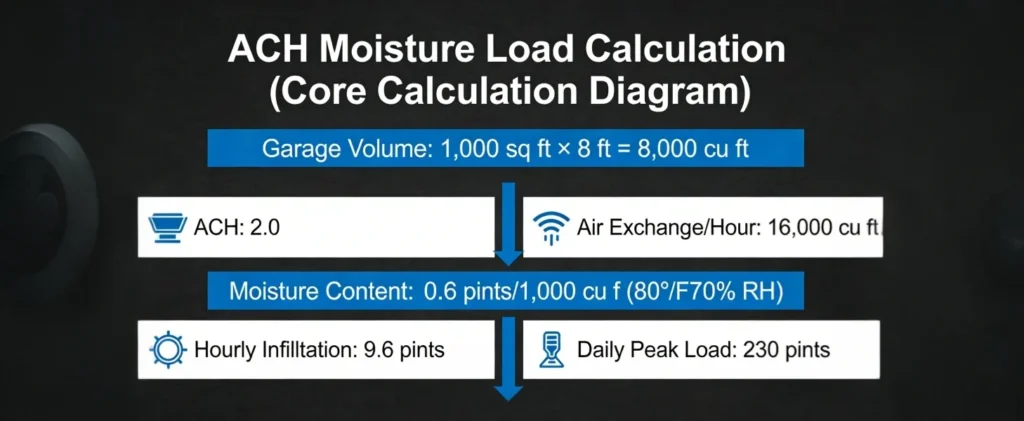
The math: A 1,000 sq ft garage with 8 ft ceilings has 8,000 cubic feet of air. At 2.0 ACH, that’s 16,000 cubic feet of outdoor air entering every hour—each cubic foot carrying its own moisture load based on outdoor humidity.
Vehicle Carry-In
A single wet car can introduce 1-2 gallons of water via rain run-off, snowmelt, or condensation. This isn’t ambient humidity—it’s liquid water that evaporates slowly over hours, creating a sustained moisture spike.
Concrete Slab Vapor Transmission
Concrete slabs add moisture through vapor transmission: 3-8 pounds of moisture per 1,000 square feet daily, depending on soil conditions and slab sealing. This is continuous, 24/7, regardless of ventilation.
Pressure Imbalances
In attached garages, pressure imbalances can draw humid air from the house or outside at rates exceeding normal ACH, worsening the problem during HVAC operation.
These combined inputs are quantifiable. Without accounting for each source, humidity control becomes inconsistent.
📌 New to garage dehumidification? Start with our [Step-by-Step Climate Guide] for a beginner-friendly overview.
PPD (Pints Per Day): Beyond the AHAM Rating
PPD is the most cited metric, but it’s also the most misunderstood.
What PPD Actually Measures
The AHAM (Association of Home Appliance Manufacturers) standard tests dehumidifiers at 80°F and 60% RH. This is a controlled lab condition—not a garage.
How Real-World Conditions Affect PPD
Condition | Impact on Effective PPD |
Lower temperatures (below 65°F) | Capacity can decrease significantly (often 15% or more depending on conditions) |
Higher humidity (above 80% RH) | Unit works harder; effective capacity may increase but runtime extends |
Rapid air changes (high ACH) | Effective capacity may be reduced substantially in high-infiltration spaces |
Poor airflow around unit | 10-25% reduction based on field observations |
Note: These ranges are based on field observations and engineering estimates; actual performance varies by unit and conditions.
Example: A unit rated at 70 PPD under AHAM conditions, placed in a 55°F garage with 2.5 ACH, may deliver considerably less than its rated capacity—potentially 40-45 PPD of actual moisture removal depending on specific conditions.
Calculating Your Required PPD
To determine needed capacity:
- Start with volume: 10-15 pints per 500 sq ft baseline for moderately sealed spaces
- Add for vehicles: +5 pints per vehicle bay
- Add for poor insulation: +10-15%
- Adjust for ACH: If your garage has visible gaps, add +20%
- Apply climate factor: Humid climates add +15%; cold climates require low-temp capability but not necessarily higher PPD
Rule of thumb: Choose a unit with PPD rating 20-30% higher than your calculated load to handle peak conditions without constant cycling.
📌 For detailed sizing help with climate factors, see our [What Size Dehumidifier Do I Need?] guide.
Airflow (CFM): The Overlooked Metric
CFM (cubic feet per minute) determines how quickly and evenly air is processed. It’s arguably as important as PPD, yet rarely discussed.
Why CFM Matters in Garages
Garages have:
- Obstructions (vehicles, storage)
- High ceilings
- Poor natural air movement
- Temperature stratification
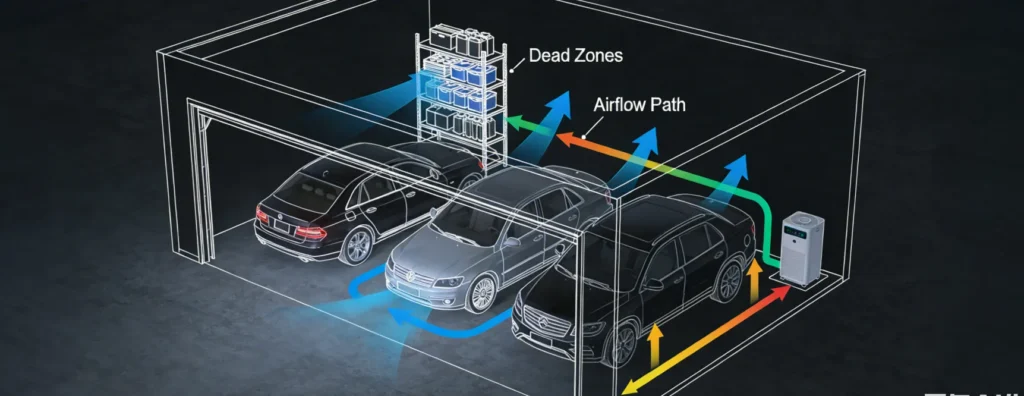
Without adequate CFM, you get humidity pockets—areas behind vehicles or in corners where RH remains high even when the unit runs continuously.
Calculating CFM Needs
A general guideline: your dehumidifier should be able to cycle the entire garage volume every 1-2 hours.
Formula: Garage Volume (cu ft) ÷ Desired Air Change Rate (60-120 minutes) = Required CFM
Example: 1,000 sq ft garage with 8 ft ceilings = 8,000 cu ft
- For 1-hour cycle: 8,000 ÷ 60 = 133 CFM minimum
- For 30-minute cycle (high moisture): 8,000 ÷ 30 = 267 CFM recommended
CFM vs. PPD: Finding Balance
Scenario | Priority |
Large open garage with good circulation | PPD > CFM |
Garage with many obstacles/storage | CFM critical |
High humidity + vehicles | Both equally important |
Cold climate (condensation focus) | CFM for air movement |
Most residential units offer 150-250 CFM. Commercial units like the AlorAir Sentinel SLGR 1400X deliver 440 CFM, covering large spaces without dead zones.
ACH (Air Changes Per Hour) and Moisture Load Calculation
ACH is the foundation of moisture load math. Here’s how to use it.
Estimating ACH Based on Construction
Garage Type | Typical ACH* |
New construction, well-sealed | 1.0-1.5 |
Average garage, some gaps | 1.5-2.5 |
Older garage, visible gaps | 2.5-4.0 |
Unfinished, large door gaps | 4.0+ |
*These ranges are based on field observations of typical garage construction. Actual values vary widely based on sealing, door condition, and climate.
Calculating Peak Moisture Intake from ACH
Step 1: Find your garage volume (Length × Width × Height)
Step 2: Estimate ACH based on construction
Step 3: Calculate air exchange per hour:
Volume × ACH = Cubic feet of air exchanged per hour
Step 4: Convert to theoretical moisture load:
Based on standard psychrometric calculations, at 80°F and 70% RH, each 1,000 cubic feet of air contains approximately 0.5-0.7 pints of water vapor.
Example calculation (peak conditions):
- Garage: 1,000 sq ft × 8 ft = 8,000 cu ft
- ACH: 2.0
- Air exchanged per hour: 16,000 cu ft
- Outdoor conditions (peak): 80°F, 70% RH (≈0.6 pints per 1,000 cu ft)
Theoretical peak infiltration load:
- 16,000 ÷ 1,000 × 0.6 = 9.6 pints per hour
- 9.6 × 24 = 230 pints per day
This represents the gross moisture entering from infiltration under peak conditions. Net load depends on the humidity differential between indoor and outdoor air, which varies throughout the day. Actual dehumidifier requirements will be lower, but this calculation illustrates why undersized units fail during peak humidity events.
Low-Temperature Operation: The Cold Garage Problem
Standard dehumidifiers are designed for conditioned spaces. Garages break those assumptions.
Why Standard Units Fail Below 60°F
Below 60°F, two problems emerge:
- Coil icing: Moisture freezes on evaporator coils instead of draining
- Reduced efficiency: Lower air temperature holds less moisture, but the unit still runs constantly
Defrost Cycles: How They Work
Units with defrost capability periodically:
- Stop compression
- Run fan only (or reverse cycle)
- Melt ice buildup
- Resume dehumidification
Defrost cycle impact: During defrost, zero dehumidification occurs. In very cold garages, a unit may spend significant runtime in defrost, further reducing effective capacity.
Specs to Look For
Feature | Recommendation |
Low-temperature operation | Rated down to at least 40°F |
Auto-defrost | Recommended for cold climates |
Compressor type | Rotary compressors generally handle cold better |
Drain hose freezing | Consider heat tape for exposed drain lines |
📌 For complete maintenance and troubleshooting, see our [Dehumidifier Troubleshooting & Maintenance Guide].
Energy Efficiency (L/kWh): Running Cost Analysis
L/kWh (liters per kilowatt-hour) measures how much water a dehumidifier removes per unit of electricity.
What the Numbers Mean
L/kWh Rating | Efficiency | Annual Operating Cost (Est.)* |
Below 1.5 | Poor | $200-300 |
1.5-2.0 | Average | $150-200 |
2.0-2.5 | Good | $120-150 |
Above 2.5 | Excellent | Below $120 |
**Estimated based on continuous operation in humid climate, assuming $0.15/kWh average electricity rate. Actual costs vary by region and usage patterns.*
When Efficiency Justifies Higher Upfront Cost
Payback calculation:
(Price difference) ÷ (Annual operating cost savings) = Years to break even
Example:
- Unit A: $400, 1.8 L/kWh ($180/year estimated)
- Unit B: $600, 2.4 L/kWh ($120/year estimated)
- Annual savings: $60 estimated
- Payback period: ($200 difference) ÷ $60 = 3.3 years estimated
If you plan to run the unit for 5+ years, higher efficiency may pay off depending on your local electricity rates.
Drainage Engineering: Pump vs. Gravity
Beyond “pump is convenient,” there’s engineering to consider.
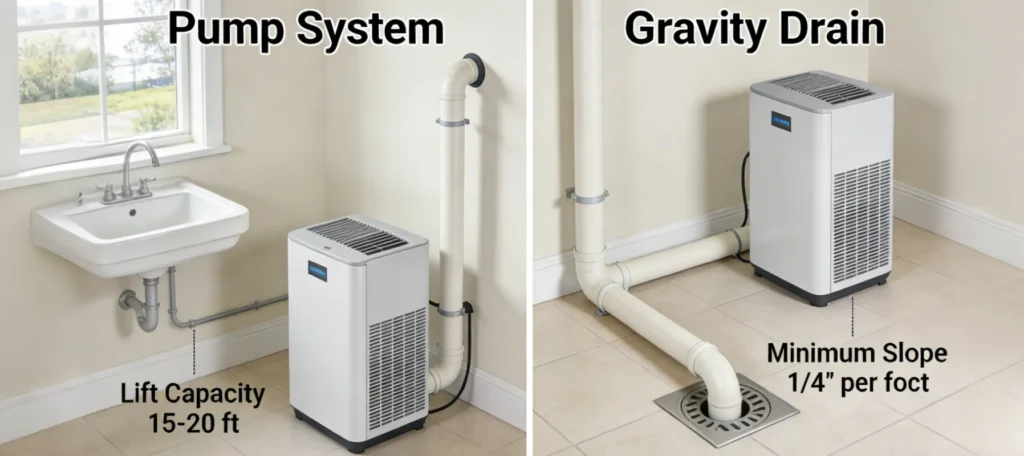
Pump Systems
Typical pump specs:
- Lift capacity: 15-20 feet vertical
- Horizontal run: Up to 100 feet
- Flow rate: 2-5 gallons per hour
Engineering considerations:
- Head pressure reduces flow over long runs
- Check valves prevent backflow
- Pump cycles: Frequent short cycles wear pumps faster
Gravity Drain Systems
Requirements:
- Minimum slope: 1/4 inch per foot
- No low spots where water can pool
- Drain exit below unit level
Reliability comparison: Gravity systems have fewer failure points but require proper installation.
When Each Makes Sense
Scenario | Recommendation |
No floor drain, need to reach sink | Pump required |
Floor drain available | Gravity (simpler) |
Drain exit above unit level | Pump required |
Freezing temps | Pump with heated discharge or gravity below frost line |
Data Comparison: Garage vs. Whole-House Systems
Standalone garage dehumidifiers and whole-house systems differ measurably in performance for garage applications.
Performance Comparison
Metric | Garage-Specific Unit | Whole-House System |
PPD per dollar | Higher | Lower |
Installation complexity | Plug and play | Ductwork required |
Low-temp operation | Often rated for 40°F+ | Typically 60°F+ minimum |
Airflow (CFM) per sq ft | Higher (focused on one space) | Lower (designed for distribution) |
RH pull-down speed | Fast (hours) | Slower; may struggle with high ACH |
Maintenance | Simple, on-site | Requires HVAC tech |
Field Observations
When used for an attached garage without dedicated ducting, whole-house units may show significantly lower effective moisture removal due to:
- Mixing inefficiencies
- Air dilution
- Duct losses
- Return air restrictions
Bottom line: For dedicated garage dehumidification, a garage-specific unit generally outperforms a whole-house system in most metrics except whole-home integration.
📌 Learn more: [Whole House Dehumidifier: Pros, Cons & Is It Worth the Cost?]
Engineering Summary: Matching Metrics to Your Garage
Garage Condition | Primary Metric | Secondary Metric | General Guideline |
Large (1,200+ sq ft) | CFM | PPD | 300+ CFM recommended |
High humidity climate | PPD | Low-temp range | 70+ PPD typically needed |
Cold climate | Operating temp | Defrost cycle | Rated to at least 40°F |
Frequent wet vehicles | PPD | Drainage type | 70+ PPD with pump recommended |
Workshop/storage | CFM | Even distribution | 250+ CFM suggested |
Attached to house | ACH calculation | PPD | Size based on calculated load |
Frequently Asked Questions
How do I calculate exact ACH for my garage?
Use a blower door test for precision, or estimate based on construction. For DIY, seal the garage and run a smoke pencil around edges—heavy smoke movement indicates higher ACH.
What’s more important, PPD or CFM?
They work together. Low CFM with high PPD may create dry spots but leave humid pockets. High CFM with marginal PPD circulates air well but may not keep up with moisture load. The best systems balance both for your specific conditions.
Can I use two smaller units instead of one large unit?
Sometimes. Two units can provide better coverage in garages with obstacles, but total cost and maintenance double. One properly sized unit is usually more efficient and cost-effective.
Do I need a unit rated for continuous operation?
Garage dehumidifiers typically run longer than portable units in living spaces. Look for “continuous duty” or “commercial grade” ratings if you expect year-round operation.
How does salt air affect dehumidifier performance?
Salt accelerates corrosion on coils and components. In coastal areas, lifespan may be significantly reduced unless you choose units with epoxy-coated coils and stainless steel hardware.