
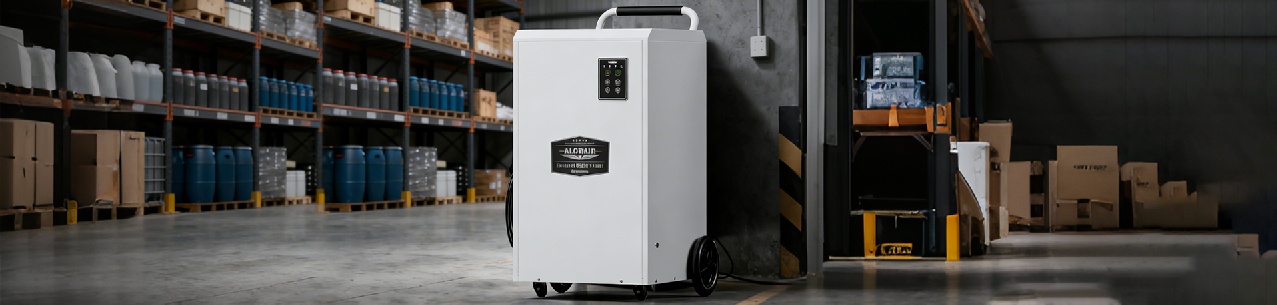






In tough industrial spaces, moisture control systems protect your equipment, materials, and facility from costly damage. To help you select the best solution, this guide explains the basics of heavy-duty dehumidification equipment, sizing tips, main types, and top AlorAir models for high-demand applications.
What Is an Industrial-Grade Dehumidifier and How Does It Work?
A heavy-duty dehumidifier extracts moisture from the air in large commercial and industrial spaces. It uses cooling coils to condense humidity into liquid, which is then drained away. This process maintains low relative humidity, preventing mold growth and rust formation in manufacturing facilities and warehouses.
Difference Between Industrial-Grade and Commercial Dehumidifiers
Heavy-duty moisture control units handle high humidity levels in harsh environments and are built for continuous 24/7 operation. Commercial units, by contrast, serve offices, basements, and retail spaces. Industrial models feature stronger compressors, reinforced housings, and protected coils to withstand rigorous use.
Common Industrial Applications and Use Cases
Moisture control equipment is essential in warehouses, manufacturing plants, and flood-damaged sites. It safeguards goods, machinery, and building materials from humidity-related damage. Construction drying and disaster restoration projects also rely on high-capacity dehumidification systems.
Industry-Specific Sizing Guide
Humidity requirements and space characteristics vary significantly across industrial scenarios. Accurate equipment selection must align with industry-specific challenges and core performance advantages. Below are customized sizing solutions for three high-humidity industries:
Food Processing Plants (Humidity Requirement: 40-50%)
Core challenges include mold growth, food spoilage, and compliance with food-grade hygiene standards. The AlorAir Sentinel WHD 150 is highly recommended—it features a food-grade 304 stainless steel body for corrosion resistance, an MERV-10 anti-mold filter to trap dust particles, and a moisture removal capacity of 140 pints per day, suitable for workshops of 3,500 square feet. Equipped with eco-friendly and odorless R32 refrigerant, it fully complies with QS and ISO 22000 certification requirements, making it the top choice for food processing facility moisture control.

Electronics Factories (Humidity Requirement: 35-45%)
Key concerns involve electrostatic interference and moisture damage to components, demanding stable control of low humidity levels. The AlorAir Sentinel SLGR 1400X excels in this scenario—its SLGR low-temperature dehumidification technology enables operation at 33°F, with humidity control precision of ±2%. Its 440 CFM high airflow quickly balances humidity in workshops, while the anti-static coated body eliminates electrostatic hazards. Compliant with OSHA humidity regulations for electronics manufacturing, it serves as a reliablecold-climate dehumidification solution for winter operations.
Printing Workshops (Humidity Requirement: 50-60%)
Main issues are paper deformation and ink bleeding, requiring precise humidity control and low noise operation. The AlorAir Sentinel WHD 200 is an ideal fit, with a moisture removal capacity of 165 pints per day covering 4,500 square feet of workshop space. Operating at 65dBA, it ensures no disruption to production; its flexible duct design adapts to complex workshop layouts, and precise humidity control prevents excessive paper expansion/contraction, improving the qualification rate of printed products.
Types of Heavy-Duty Dehumidification Systems
Different environments require specificmoisture control technologies—choosing the wrong type can waste energy and shorten equipment lifespan.
Refrigerant-Based Heavy-Duty Dehumidifiers
These systems work best in warm and humid conditions, offering high efficiency and lower operating costs. Most industrial moisture control units use this proven technology.
Desiccant Dehumidifiers for Industrial Use
These units are ideal for applications requiring low humidity in cold environments. They absorb moisture directly from the air onto a rotating desiccant wheel, which is then regenerated using heat. While these systems consume more energy, they excel in extreme conditions.
Hybrid Industrial Moisture Control Units
Hybrid systems combine refrigerant and desiccant components, automatically adjusting to changing conditions. They use less energy than single-type units in mixed climates, and while initial costs are higher, long-term energy savings justify the investment.
How to Size Heavy-Duty Dehumidification Equipment Correctly
Choosing the right size ensures effective moisture control without wasting energy. An undersized unit will struggle continuously, while an oversized one will cycle unnecessarily, driving up power costs.
Calculate Moisture Load and Air Volume
To size your system, first calculate the room’s volume. Then account for extra moisture from people, machines, and open doors. Multiply the volume by an air infiltration rate—0.5 air changes per hour works for tight spaces. For instance, a 10,000 cubic-foot warehouse typically requires aunit with a 200-pint daily moisture removal capacity.
Environmental Factors That Affect Sizing
High temperatures increase air’s moisture-holding capacity, while humid climates can add up to 20% more load. Ventilation introduces moist outside air, and cold spots reduce refrigerant-based system efficiency. Check local humidity data before finalizing your equipment selection.
Matching Capacity to Your Needs
Align the unit’s pints per day (PPD) rating with your calculated moisture load. AHAM tests units at 80°F and 60% relative humidity—add 10% extra capacity for safety. For a 300-pint load, choose a 330-pint unit. Consult manufacturer sizing charts, such as those from AlorAir, for exact fits.

Key Features to Look for in High-Performance Moisture Control Equipment
In harsh industrial conditions, only durable, reliable units can keep up. These qualities separate the best moisture control systems from the rest.
Moisture Removal Capacity and Efficiency
Choose units with high pints-per-day (PPD) capacity and a Coefficient of Performance (COP) over 2.5 for efficient energy use. According to ASHRAE standards, a COP exceeding 2.5 indicates high energy efficiency for dehumidification systems. Check performance data for standard, real-world conditions, not just maximum test settings—this ensures true operational value and cost savings.
Durability, Housing, and Coil Protection
A rugged, rotomolded plastic housing can withstand the bumps and knocks of job sites. This manufacturing process creates seamless, impact-resistant casings that are more resistant to abrasion and chemical exposure than injection-molded alternatives. Inside, special anti-corrosion coatings protect coils from salty or harsh air. Washable filters keep dust out of the motor, and auto-defrost prevents icy coils in cool spaces.
Built-In Pump: When You Need It
Moisture control units with built-in pumps are ideal for setups without floor drains, saving time on manual emptying—particularly in multi-level buildings or remote sites. A built-in pump pushes water uphill or across long distances (easily over 50 feet), eliminating the need for manual bucket emptying during shifts and ensuring smooth, continuous workflow.
Energy Consumption and Operating Costs
Energy use directly impacts operational costs. Units with a high Coefficient of Performance (COP) are more efficient and can save enough on electricity to offset their initial cost within about two years, depending on local rates. Monthly running costs typically range from $20–$60 at 12¢/kWh. Choosing energy-efficient models with strong warranties ensures reliable performance and long-term value.
Common Mistakes to Avoid
Heavy-duty moisture control equipment represents a significant capital investment—avoid these pitfalls to maximize value and lifespan:
Mistake 1: Prioritizing PPD Over COP
Many buyers focus solely on moisture removal capacity (PPD) and overlook efficiency (COP). A 200-PPD unit with a COP of 1.8 costs $300 more monthly in electricity than an AlorAir Sentinel WHD 150 (same PPD, COP 3.7)—the annual energy premium exceeds the unit’s price difference. Solution: Compare AHAM-rated COP alongside PPD; AlorAir’s heavy-duty lineup maintains COP ≥2.8.
Mistake 2: Ignoring Efficiency Loss in Low Temperatures
Standard refrigerant-based units lose 50%+ efficiency below 50°F, leading to “running but not dehumidifying” issues in winter. Solution: Select SLGR-technology units for cold environments—AlorAir’s SLGR 1400X retains 85% efficiency at 33°F.
Mistake 3: Inadequate Dust Protection
Industrial dust clogs filters and abrades coils, reducing equipment lifespan by 50%. Solution: Choose units with MERV-10+ washable filters and coil anti-corrosion coatings—these extend service life to 8+ years.
Mistake 4: Poor Drainage Planning
Multi-level facilities or remote sites without floor drains require manual water emptying if no pump is installed, causing costly downtime. Solution: Opt for built-in pump models like the Sentinel WHD 150, which handles 50+ foot vertical/horizontal drainage—aligning with the needs of facilities without easy access to floor drains.
Mistake 5: Overlooking After-Sales Support
Low-cost units often lack local service, leading to 4+ week repair wait times. Solution: Choose brands with 5-year warranties and nationwide service networks (e.g., AlorAir). 24/7 technical support and next-day parts delivery minimize production disruptions.

Installation Guidelines and Maintenance Planning
Professional Installation for Optimal Performance
- Location Selection: Install in well-ventilated areas, away from heat sources and direct sunlight
- Drainage Setup: Ensure proper slope (1/4 inch per foot) in drainage pipes to prevent water accumulation
- Power Requirements: Use dedicated circuits, avoiding sharing with other high-power equipment
- Air Circulation: Maintain at least 18 inches of clearance around intake and exhaust vents
Comprehensive Maintenance Schedule
Maintenance Task | Frequency | Instructions |
|---|---|---|
Filter Cleaning | Monthly | Wash with mild detergent, reinstall only when completely dry |
Drainage System Check | Quarterly | Inspect drainage pipes for clogs, clean drain pans |
Coil Cleaning | Every 6 months | Use soft brush and coil cleaner to remove dust and grime |
Comprehensive Inspection | Annually | Check compressor, fan motor, and all electrical connections |
Performance Verification | Annually | Use hygrometer to confirm dehumidification efficiency meets standards |
SLGR Technology Explained: Smart Low Grain Refrigerant System
SLGR (Smart Low Grain Refrigerant) technology is AlorAir’s patented innovation that enhances energy efficiency through:
- Intelligent Regulation: Automatically adjusts compressor cycle based on ambient humidity
- Low-Temperature Optimization: Maintains efficient dehumidification in cold environments via hot gas bypass valve
- Precise Humidity Control: ±3% humidity control accuracy prevents energy waste from over-dehumidification
- Enhanced Efficiency Ratio: Delivers 15-20% higher dehumidification efficiency compared to conventional technologies under identical conditions
The core of this technology lies in its dual-temperature sensor system and adaptive algorithm, which continuously monitors evaporator and condenser temperatures to optimize refrigerant flow paths, ensuring peak efficiency across various environmental conditions.
Top Picks: High-Performance Moisture Control Units for Different Needs
Choosing the right unit depends on the scale of your challenge and the specifics of your environment. For performance engineered to master these industrial demands, explore the robust and reliable solutions from AlorAir.
Best Heavy-Duty Unit with Built-In Pump
The Sentinel WHD 150 offers pump options, removing 140 pints daily with 3.7 COP efficiency. It handles 3500 square feet inhigh-humidity areas, with built-in defrost to extend coil life and an MERV-10 filter to trap factory dust. It’s also strong for water damage restoration jobs.
Best for Manufacturing Facilities
Choose the Sentinel WHD 200 for plants—it pulls 165 pints daily over 4500 square feet. R32 refrigerant cuts energy use, flexible ducts fit production lines, and it runs quietly at 65 dBA. A five-year warranty backs its reliability.
Best for Large Warehouses
The AlorAir Sentinel SLGR 1400X stands out, removing 140 pints at AHAM and 275 at saturation. It covers 3800 square feet with 440 CFM airflow, and SLGR tech boosts efficiency in damp air. Auto-defrost works down to 33°F, and it weighs 124 pounds for easy movement.
Conclusion and Action Plan
AlorAir dehumidifiers feature SLGR technology and eco-friendly R32, saving up to 20% more energy than standard units. With these efficiency gains, you can protect your operations from moisture damage using reliable, industrial-grade performance.
Your Next Steps:
- Assess Your Needs: Measure your space dimensions and identify primary moisture sources
- Calculate Load Requirements: Use our online sizing calculator to determine required capacity
- Consult Experts: Schedule a free on-site evaluation for personalized recommendations
- View Demonstrations: Visit product pages to watch actual operation videos
Explore AlorairNest industrial dehumidifiers for efficient, long-lasting moisture control. Make the right choice, and moisture problems will become a thing of the past.
