
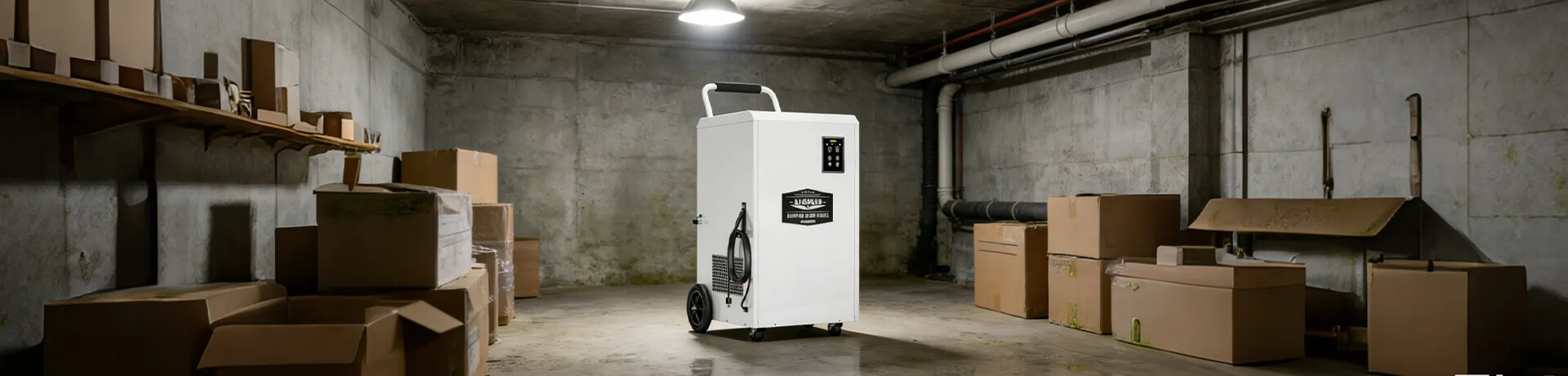





Mold growth depends not on dirty surfaces but on prolonged relative humidity (RH), which enables mold spores to become activated and colonize building materials. Data from indoor air quality studies indicates that mold is quite inactive below 50% RH, and environments that consistently exceed 60% RH are in an “activation” zone where mold growth is very rapid. This is the reason why surface cleaning alone does not provide long-term results.
A dehumidifier for mold is an environmental control system that lowers the level of air-borne moisture to the point that it deprives mold of the condition it needs to grow, effectively halting its life cycle. In this guide, you will discover when a dehumidifier works, how much moisture removal capacity is needed based on measurable conditions, and which types of systems can effectively suppress mold throughout large residential spaces, rather than just providing temporary relief.
Quantifying Mold Risk: Humidity Levels, Exposure Time, and Growth Acceleration
Mold risk is best assessed based on time-above-threshold exposure, rather than single humidity spikes. Data indicate that environments with 60% RH for 8-12 hours a day are sufficient for spores to already activate in porous materials; continuous exposure at the same level causes a dramatic acceleration of colonization. The risk curve becomes even steeper with black mold. At 65-70% RH, growth will increase measurably within days; at 75% and above, colonization may be exponential, especially in low-airflow zones like basements and wall cavities.
This answers both questions: what is the humidity level at which mold grows, and how long does mold survive in high humidity? Duration is as important as percentage. Effective mold control requires that the relative humidity be at or below 50% at all times, not at one extreme or the other. Intermittent drying may slow growth for a short time, but this does not destroy the biological conditions that molds require to survive and spread.
Does a Dehumidifier Remove Mold?
It is critical to separate the outcome: removing dehumidifier mold does not mean killing existing colonies. Laboratory and field data indicate that below 50% RH, relative humidity in the indoor environment inhibits mold spore growth because moisture-dependent metabolic processes cannot occur. Following humidity stabilization, quantifiable growth slowdown generally follows within 24-48 hours, in the absence of added moisture.
A dehumidifier that eliminates mold is useful in two situations: the first one is when the colonization process is in its early stages, and the spores have not yet penetrated the materials deeply, and the second is when the moisture is to be controlled after a remediation process, and the physical removal of the mold has already been performed.
Dehumidifiers fail when mold resides in wall voids and cracks where moisture is trapped, or where there is continuous moisture intrusion through cracks, groundwater pressure, or condensation. In those cases, humidity reduction alone cannot offset continuous water availability, and mold activity resumes despite surface-level RH control.

Performance Metrics That Define the Success of Mold Suppression
PPD (Pints Per Day) vs Daily Moisture Load
Mold suppression requires adjusting the dehumidifier output inversely to the actual moisture input. PPD should be larger than the daily moisture load (outdoor air infiltration, evaporation from damp materials, plumbing sources, and the above codes for occupant-generated humidity). For example, environments where environmental factors introduce 8-10 gallons of moisture per day need well over that for a storage unit to maintain odor-avoiding RH levels.
CFM and Air Turnover: RH Uniformity Matters
Airflow (CFM) directly affects how uniformly moisture is removed. Low air turnover leads to localized pockets of humidity, allowing mold to persist despite what average RH readings might indicate as acceptable. Uniform RH control needs adequate air movement in all zones.
Coverage Area vs Real-World Performance Loss
Manufacturer coverage ratings do not usually consider ceiling height, compartmentalization, or air leakage. In practice, effective capacity typically declines by 20-40%, making mold suppression less reliable in larger or more complex layouts.
Energy Factor (L/kWh) and Continuous Operation
Sustained mold control is a 24/7 operation. Units with poor energy efficiency (L/kWh) cannot be run continuously without incurring high costs or heat output (cycling and RH rebound).
Why Consumer Units Break Over ~1,500 sq ft
Most consumer models do not provide the PPD capacity, airflow, and efficiency for large volumes. A properly specified dehumidifier for mold must provide excess moisture removal, stable, continuous airflow, and energy-efficient operation.
Whole-Home vs Commercial Dehumidifiers: Measurable Outcome Differences
RH Pull-Down Speed and Moisture Control Response
The most immediate performance difference between whole-home and commercial systems is that of RH pull-down speed. Commercial units are designed to dehumidify from 65% down to 45% RH in a matter of hours, but whole-house equipment is typically built for longer, better-controlled cycles. Faster pull-down is very important in high moisture or post-remediation settings, whereas gradual stabilization is adequate for long-term prevention.

Stability Impacting 30-Day Operating Cycles
Long-term data have shown that whole-home systems keep the RH under control to +-3-5% for 30-day cycles when the system sizes are correct. Undersized units are subject to frequent cycling, which causes RH rebound that recreates mold conditions.
Why Capacity is More Important Than Cost
The best dehumidifier for mold is one that offers high moisture-removal capacity at a low cost, which is not reflected in the initial price. Units that do not supply sufficient PPD cannot offset the daily moisture load, and high RH above safe levels is the result.
Failure Scenarios
Undersized systems often experience a 20-30% RH variance, especially in basements and other closed rooms, defeating whole-house dehumidifier mold-prevention goals. Select the best-capacity dehumidifier for mold to ensure consistent mold suppression rather than sporadic.
Applied System Examples: AlorAir Units in Mold-Control Scenarios
The following examples show how system selection changes outcomes when moisture loads are quantified rather than estimated. AlorAir produces both commercial and whole-home systems designed for continuous, data-driven humidity control, making them suitable reference points for mold-focused applications.
Sentinel SLGR 1400X – Active Mold Environments with High Load
The Sentinel SLGR 1400X is designed for use in extremely high-moisture-load environments, with high PPD output and aggressive airflow. This allows quick reduction of RH in basements, crawlspaces and other areas where moisture accumulates. In flood recovery or severe intrusion situations, pulling down is very fast, as black mold activity increases with prolonged exposure above 65% RH.
In these conditions, a black mold strategy based on dehumidification prioritizes speed and volume over gradual stabilization. The unit’s capacity makes it effective for dehumidifier-assisted mold removal, where drying is required faster than evaporation from saturated materials after mold removal.

Sentinel WHD Series (100-200) – Long Term Mold Protection
The Sentinel WHD Series is designed for scalable, whole-structure humidity control, with models determined by square footage, ceiling height, and measured moisture load. Integrated into HVAC return systems, these units allow uniform RH control in occupied spaces. Positioned as infrastructure rather than an appliance, a WHD system acts as a dehumidifier for mold prevention, maintaining a consistent RH over long cycles rather than responding to isolated moisture events.
How to Size a Dehumidifier for Mold Using Measured Inputs
Accurate sizing begins with measured inputs, not rule-of-thumb estimates. First, measure baseline relative humidity (RH) at multiple locations to define areas of peak exposure. Next, calculate the square footage and the ceiling height to calculate the total amount of air in the space, since taller spaces hold more moisture. Third, identify sources of moisture. It includes infiltration rates, damp foundations, plumbing leaks, or occupant load, in gallons per day.
These variables inform the required PPD calculation, which must exceed the total daily moisture input to avoid RH rebound. When units are undersized, there is a 20-40% shortfall in moisture removal, as data shows, leading to cycling, uneven RH distribution, and persistent mold-friendly conditions. This step-by-step approach to sizing a dehumidifier for mold provides a correct answer. It ensures the selected capacity of the dehumidifier for mold removal to provide stable humidity rather than intermittent humidity.
Timeline Expectations: What Data Shows After Installation
Once a properly sized system is in place, measurable changes occur on predictable timelines. Within 24 hours, most high-capacity systems provide an initial RH pull-down often in the 10-15% points range. At 7 days, stabilized operation means that the RH is maintained within the target range in primary zones most of the time, with limited spore activity.
By 30 days, if regrowth does not occur, sustained humidity control below mold activation levels prevents regrowth. It only happens if there are no new sources of moisture. It is important to set realistic expectations: a dehumidifier to get rid of mold does not erase existing damage, but interrupts the environmental conditions mold requires to survive. When run continuously and sized appropriately, a whole house dehumidifier for mold provides predictable suppression rather than temporary relief.
Conclusion: Mold Control is a Continuous Environmental Strategy
Effective mold control is accomplished by consistent moisture management rather than surface-level interventions. The data indicate that humidity thresholds, exposure, duration, and system capacity determine outcomes with a high degree of reliability. Selecting the best dehumidifier for mold is therefore a measurable process based on PPD, airflow, and operational stability — not brand perception or price.
Whole-home and commercial systems, if appropriately sized, serve as a preventive infrastructure that maintains conditions that inhibit mold over the long term. The important message is simple: mold suppression is predictable when humidity is controlled at all times using systems calibrated to actual moisture loads.
If you’re ready to apply these principles and find a system that’s precisely sized for your space, explore our range of engineered solutions designed for data-driven humidity control. Browse Our Mold-Control Dehumidifiers →
