







Industrial dehumidifiers are essential for controlling excess moisture in demanding environments, including warehouses, basements, and restoration sites, where water damage can halt operations. Their effectiveness, however, often hinges on a single component: the drain hose. Without proper setup and care, even the most powerful machine can falter, leading to water damage or halted operations. This guide equips you with the knowledge to handle your dehumidifier drain hose confidently, drawing from proven practices to safeguard your investment and indoor air quality.
Why Proper Drain Hose Installation is Critical
Proper drain hose installation ensures smooth water flow, allowing your industrial dehumidifier to run continuously and efficiently. Neglecting this detail invites inefficiency—or worse, water damage. The U.S. Environmental Protection Agency notes that unchecked moisture speeds up mold and decay in buildings, leading to costly fixes.
Continuous vs. Manual Drainage
Industrial spaces demand heavy and consistent moisture removal. Manual drainage, which requires emptying the tank by hand, slows work and increases the risk of flooding. In contrast, continuous drainage means the machine directs moisture straight out via a hose. This keeps the unit running without interruption. For industrial environments, always choose continuous drainage. Even with the right tools, improper handling can still cause issues. Here are common drainage problems to watch for.
Common Drainage Problems
- Dirt or mineral buildup can block hoses.
- Algae can grow inside, making the hose slimy, especially in damp basements.
- Loose connections can leak water in the wrong places.
- Poor slopes let water flow back toward the unit.
- In very humid conditions, hoses may fill quickly, revealing hidden blockages.
- In heavy-duty use, small problems add up fast.
- Regular checks prevent serious issues.
Risks of Poor Installation
Improper installation increases the risk of water damage, electrical hazards, and mold growth. Pooled water soaks floors or walls, breeding germs that harm health and work. The EPA links excess moisture to breathing problems in buildings.
Costs mount too—simple hose swaps stay cheap, but neglect strains compressors or halts systems. In business, this cuts output, making careful installation essential for steady results.
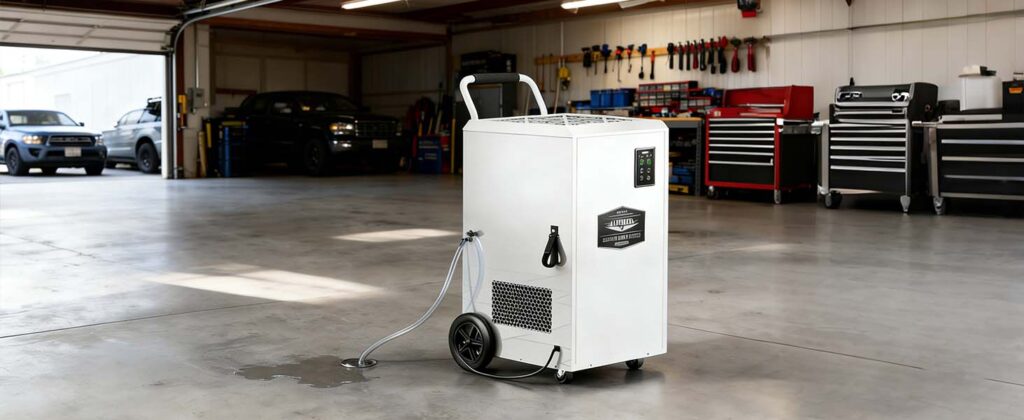
Choosing the Right System: Key Features and Comparisons
Select an industrial dehumidifier with a drain hose that matches your facility’s size and moisture conditions. Focus on durability and ease of installation to ensure reliable operation.
Key Features to Look for in Dehumidifiers with Drain Hose
- Built‑in condensate pump: Pushes water uphill or across distance.
- Quick‑connect drain port: Simplifies hose attachment.
- Durable materials: PVC or reinforced hoses resist kinks.
- Powerful moisture removal: Choose powerful, energy-efficient compressors that remove maximum moisture daily.
- Auto-defrost: Built-in auto-defrost prevents ice buildup in the lines.
- High quality filters: High-quality filters catch dust early, protecting hoses from clogs.
Gravity Drain vs. Pump-Assisted Systems
Gravity drains use natural downhill flow through a dehumidifier drain hose, offering an efficient and cost-effective solution for level areas near floor drains. They handle moderate moisture loads effectively in single-story setups without extra gear.
Pumps move water to distant or elevated drains, making them indispensable for multi-level buildings or locations lacking low-level outlets. Ideal for flood-prone zones, but they require reliable power and occasional checks. Opt for gravity in straightforward, low-elevation installations; switch to pumps when rises exceed five feet to avoid backups.
Comparing Units: With vs. Without Integrated Drain Options
Integrated ports simplify gravity drainage by removing the need for adapters and reducing leak risks. Built-in clips provide secure connections, speeding up assembly.
Non-integrated models require custom fittings, which lengthen installation time and increase the likelihood of errors. Basic units without ports rely on manual emptying, impractical for heavy industrial use. Integrated designs slash routine monitoring, saving hours weekly on oversight and tweaks.
Hose Materials, Length, and Diameter Guide
- Choose PVC or vinyl hoses for durability, as they resist kinks and corrosion better than standard plastic.
- Use 3/4-inch width for strong flow
- Lengths under 20 feet to maintain gravity pull—longer runs need pumps.
Step by Step Installation Guide
Installing a dehumidifier drain hose demands care to ensure a leak-free path. Follow these steps methodically, using tools like a level and hose clamps for precision.
Choosing the Drain Point
Identify a suitable endpoint, such as a floor drain or sump pump, positioned at least 2 feet below the unit. In industrial spaces, route away from foot traffic to prevent accidental dislodging. Measure distance accurately—excess length invites sags.
Secure Hose Connection
Attach the dehumidifier hose firmly to the unit’s port using the provided adapter or clamp. Secure the hose by twisting it firmly until snug then reinforce with zip ties to resist vibrations in high-airflow units. Avoid over-tightening, which can crack the unit’s ports. Wipe connections dry before testing, as residual moisture can cause slips or accidents. This step fortifies the system against daily rigors in commercial use.
Ensuring Proper Slope
Maintain a consistent 1/4-inch drop per foot along the hose route, verified with a level tool. Loops or rises disrupt flow, causing backups—create a gentle decline instead. For elevated drains, integrate a pump early.
Testing the System
Turn on the unit and monitor for 30 minutes, ensuring consistent drainage at the endpoint without leaks or spills. Adjust as needed, then run a full cycle to simulate load. Document flow for baseline comparisons in future maintenance. If issues arise, revisit connections immediately to avert damage.

Ongoing Maintenance and Troubleshooting
Regular maintenance prolongs the life of your industrial dehumidifier and ensures the drain hose remains clear and operational. Dedicate time monthly to inspections, adapting to your environment’s humidity levels.
Preventing Clogs & Buildup
Flush the hoses quarterly with a vinegar-water mix (1:1) to dissolve minerals and deter algae. Install an inline filter if debris is common, and avoid routing near dust sources. In high-use scenarios, weekly visual checks catch early signs of residues.
Inspection and Replacement
Inspect hoses monthly for cracks, wear, or softening, and replace them annually or after 500 hours of operation. Soften spots signal fatigue from temperature swings.
Seasonal Maintenance
Before humid seasons, dry run the system and clean ports. In winter, drain lines fully to prevent freezing, as noted in building management guides. Store spares in dry areas for quick swaps.
Troubleshooting Backups, Leaks, & Pump Failure
Backups often stem from clogs; use a pipe cleaner to dislodge them. Leaks indicate loose fittings; tighten or reseal. Pump failures may appear as inconsistent or irregular flow. Check the power supply and clear the impellers to restore proper operation. Reset via manual if needed. Persistent issues warrant professional review to protect your setup.
Why AlorAir Sentinel Dehumidifiers Reign Supreme
AlorAir units excel in high-moisture environments, engineered for reliability and superior performance compared to competing models. Tailored for industrial dehumidifier with drain hose setups, they tackle brutal condition effortlessly, proving no other brand matches their toughness and ease. Why risk inferior options when AlorAir guarantees dry spaces and zero downtimes?
AlorAir Drain Hose Design & Compatibility Features
AlorAir sets the benchmark with
- Standard 3/4-inch drain ports fit both gravity and pump hoses easily, reducing leaks and installation mistakes.
- SLGR 1400X design supports strong airflow at 440 CFM while removing up to 140 pints daily in very wet conditions.
- High-flow hose compatibility keeps drainage smooth, even during heavy moisture loads.
- Sentinel WHD series models, including WHD 150, manage airflow efficiently across areas up to 3,500 sq. ft.
- Better connections and airflow control lower hose failures and improve long-term reliability.
Top AlorAir Models with Superior Drain Hose Compatibility
AlorAir Sentinel SLGR 1400X Commercial Dehumidifier
The SLGR 1400X excels in industrial and restoration applications, removing up to 140 pints daily (275 in saturation) across 3,800 square feet with 440 CFM airflow Gravity drainage hooks up seamlessly to standard hoses, auto-defrost keeps lines clear. At 3.27 L/kWh efficiency and cETL-certified, it is the go-to for non-stop dry ops. Details here.
AlorAir Sentinel WHD 200 Whole Home Dehumidifier
The WHD 200 is suitable for large homes or commercial spaces, removing up to 165 pints daily across 4,500 square feet with ducted configurations. The built-in gravity drainage system connects easily to hoses, allowing automatic emptying without the need for buckets. The motorized damper enhances airflow while maintaining energy efficiency at 3.3 L/kWh. See more.
Choose the AlorAir Sentinel series for reliable moisture removal, easy drain hose installation, and energy efficiency of 3.7 L/kWh. Protect your spaces from water damage with cETL-certified durability and consistent performance.
